Beware the Plait-Men
Beorcham wrote in the Berkhamsted Review, May 1952: “Rightly or wrongly, the straw plait buyers were regarded as “spivs”; their morals, too, were often questioned. Over 100 years ago a ballad called Ladies! Beware of the Plait-Men! was printed, telling the story of a parson’s daughter who was lured away by a “naughty, naughty plait-man” who was already married:
Oh, night and day, you maidens gay,
Mind well what you are at;
Beware of all the naughty men
Who deal in ladies’ plait;
They will strive for to deceive you
Like the parson’s daughter gay,
Then ’twill be ‘Why, who’d have thought it’?
If you chance to cut away.”
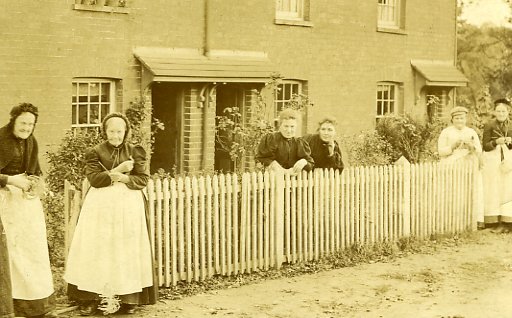
Photo of ladies plaiting straw standing in front of a terrace. Lady on left is holding a coiled length. The second lady appears to holding straw which is in a “tangle” near the ground. The two on the right are also plaiting…
The seventh Earl of Bridgewater (1753-1823) was interested in new farming methods and kept a close eye on his vast estate. At a meeting in Aylesbury, he is noted as saying that he was “shocked to find the boys knew nothing of farming; nothing but the straw-plaiting and lace-making their mothers had taught them” and he at once set out “to root out their effeminacy and instill into them manly principles” by setting up an agricultural school in Little Gaddesden which continued for many years (D. Coult, A Prospect of Ashridge, p.167).
Women were able to supplement the household income from straw plaiting and they benefited from an embargo on imported straw during the Napoleonic war. A notice appeared in the Caledonian Mercury in 1813 to straw hat manufacturers: “this is to inform those who may purchase [straw plait from French prisoners], that a fine of Ten Pounds Sterling is exigible [taxable]… as the encouragement of this illicit trade may be the means of ruining the families of many thousands in England… who are entirely supported by the manufacturing of this article”.
By Jan-1820 however, a publicized petition included Mrs Augustus Pechell and other Berkhamsted ladies: “The diminished use of Straw Hats… throws numberless women and families into distress, who have hitherto derived subsistence and comfort from their industry… the undersigned have therefore determined immediately to give such orders as they flatter themselves may not be altogether useless.” (Morning Post).
“The farmers complain of it, as doing mischief, for it makes the poor saucy [meaning independent], and no servants can be procured, where this manufacture establishes itself.” (Arthur Young, General View of the Agriculture of the County of Hertfordshire, 1804).
Nigel Goose concluded in his article: How saucy did it Make the Poor? The Straw Plait and Hat Trades, Illegitimate Fertility and the Family in Nineteenth-Century Hertfordshire, that “despite the opinions of many contemporaries—the straw plait and hat trades were a makeweight [supplemented the household income] rather than the mainspring [driving force] of change.”
 Berkhamsted Local History & Museum Society