Don’t you just love maps? They bring stories alive! The Society has a large collection of historical maps.
Beorcham wrote about cockfighting in the Berkhamsted Review, Jan 1957…
“Not pleasant to recall is Hertfordshire’s long, dishonourable interest in cockfighting. The district around Marsworth remained a stronghold of this ‘sport’ long after it was made illegal, and tradition has it that this ‘No Man’s Land’ was chosen because the promoters of cockfights could easily dodge from Herts to Bucks, or vice versa, if pursued by the police. In the bad old days, almost every common was the scene of cockfights on Sundays. Perhaps the long-forgotten ‘Cokke Inn’ [which gave King’s-road its old name of Cock-lane, later Cox’s-lane] at Berkhamsted derived its name from the ‘sport’. At St Albans – a city once notorious for bull-baiting as well as for cockfighting – there is still an historic inn with the tell-tale name ‘The Fighting Cocks’ [still alive and kicking despite difficult circumstances].”
Meersworth (Marsworth) in No Man’s Land…
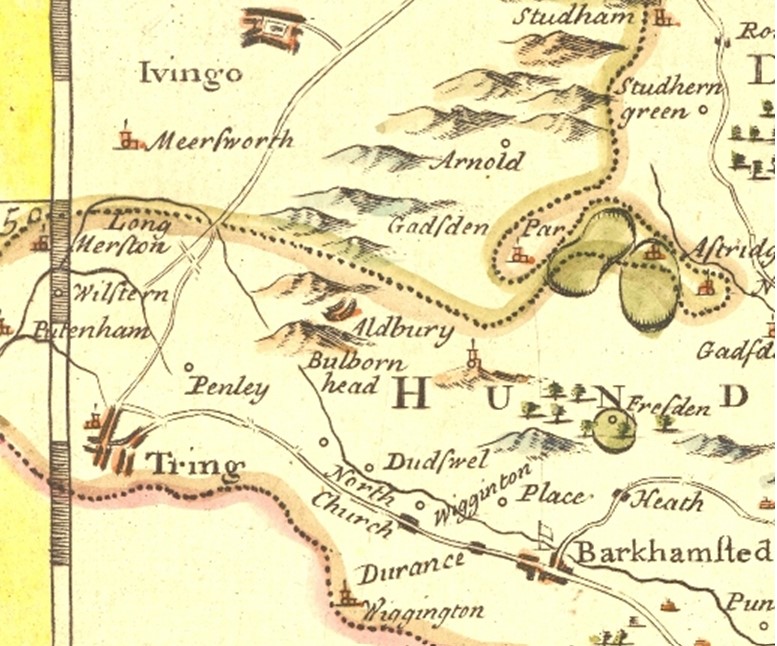
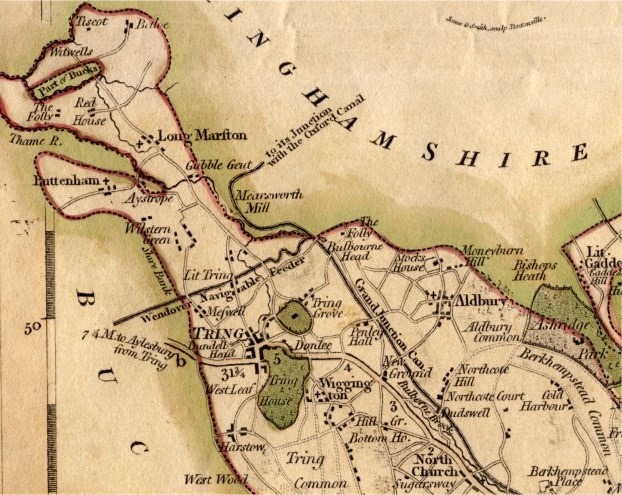
Hertfordshire’s Lake District…
“… a region of large fields, huge reservoirs, small branch canals and one ripped-up railway. But the lanes are still there to take me from Tringford to Thistle Brook, the county boundary. Ah, those rustic names – Astrope, Long Marston, Startopsend, Gubblecote, Wilstone, Puttenham. Let’s say them again and sing heigh-ho for Betlow, Tiscott and Boarscroft. I especially like Puttenham. It is small and quiet and nice. There are only 70 people in the village, and they lavish love and money on their church despite shameful setbacks. Twice in three years thieves have stripped lead off the roof. It is cheering to turn to a memorial expressing thankfulness for the safe return of every man of Puttenham who went forth to serve in the first World War. There are only two other churches in England with similar war memorials.” (Townsman, Berkhamsted Review, Nov 1965).
Between May 1969 and June 1970, Percy Birtchnell, known as “Beorcham”, offered his readers the chance to combine exercise with an appreciation of the countryside with his popular series of local walks. So popular were they that pages were torn out of the Berkhamsted Review so that walkers could take his instructions and maps with them. That’s how we are missing walks 3, 4 and 6 (let us know if you find them). So if you need to get some steps in, try Beorcham’s Walks!
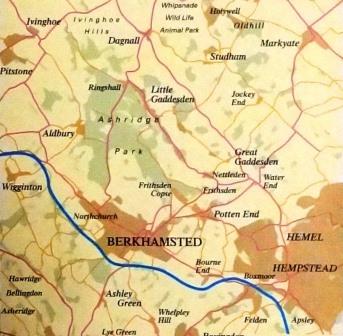
John Cook noted in the Berkhamsted Review in 2000: “Bill Willett, maker of the Berkhamsted Citizens Association new footpath map, has pointed out an interesting change in our countryside that has taken place since the last version of the map came out: he has found in plotting his map and checking it on the ground that there is much more woodland now than was the case then… lots more trees today – in the Town and in the countryside round about – than there were 60 years ago.”
 Berkhamsted Local History & Museum Society