
In 1955, Beorcham described a new acquisition to the Local History Society – a halfpenny!
Not an ordinary halfpenny of course ; it is a tradesman’s token, almost as large as a penny, and an interesting memento of the time when pillow-lace making was a thriving cottage craft in Berkhamsted. On one side of the token is the figure of a young lace-maker, plying her bobbins as she sits demurely on a grassy bank beneath a tree. Above this rustic scene are the words “Lace Manufactory.” The other side of the token is less artistic: a rather poor representation of a sheep and the date 1794, encircled by the words “Pay at Leighton, Berkhamsted or London.”

Henry Nash, whose Reminiscences of Berkhamsted appeared in 1890, was old enough to remember seeing “some ancient dame” in 18th century costume jingling her bobbins and being admired by children who “looked with longing eyes upon the rich adornment of her pillow.” The lace-makers observed the custom known as “Keeping Kattern.” On the day of their patron saint, St. Catherine, they held parties for which “Kattern” cakes were baked. In this district Wigginton was, I believe, the last place to “Keep Kattern.” In some towns and villages the lace-makers elected their “queen” and went in procession, singing a traditional ballad, to receive “Kattern” money.
We still have Mrs J. Deacon, of Ravens Lane, to delight audiences with talks of the craft and to give demonstrations on a pillow that was owned by her grandmother. It is fascinating to watch her nimble fingers as she works on patterns of some antiquity.
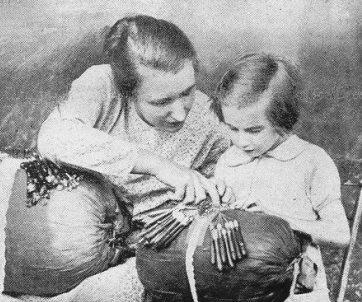

Looking at Granny’s work – The making of pillow lace has almost died out in the English countryside. Mrs Deacon of Berkhamsted, whose family has made lace in this way for generations, is here seen teaching her daughter the craft of her grandmothers.
 Berkhamsted Local History & Museum Society